
Artificial intelligence (AI) has become ubiquitous in tourism, yet research on “AI aversion” (i.e., the preference for human over AI providers) remains fragmented. This meta-analysis synthesizes 286 effect sizes from 46 experimental studies (2019–2025) to establish a causal benchmark and identify relevant boundary conditions. Results reveal a significant overall preference for human agents, culminating in an “intention bottleneck” where neutral appraisals fail to translate into behavioral choices. Aversion is also context-dependent: it intensifies with highly human-like or embodied AI and in luxury, domestic, or high-stakes travel settings. It weakens or even reverses in standardized hotel settings and in highly embarrassing situations where AI’s lack of judgment is advantageous. Demographically, older, female, and Western tourists exhibit stronger resistance. These findings shift the AI-related narrative from absolute aversion to conditional acceptance. Corresponding guidance is offered for deploying AI in ways that complement rather than disregard tourists’ needs.
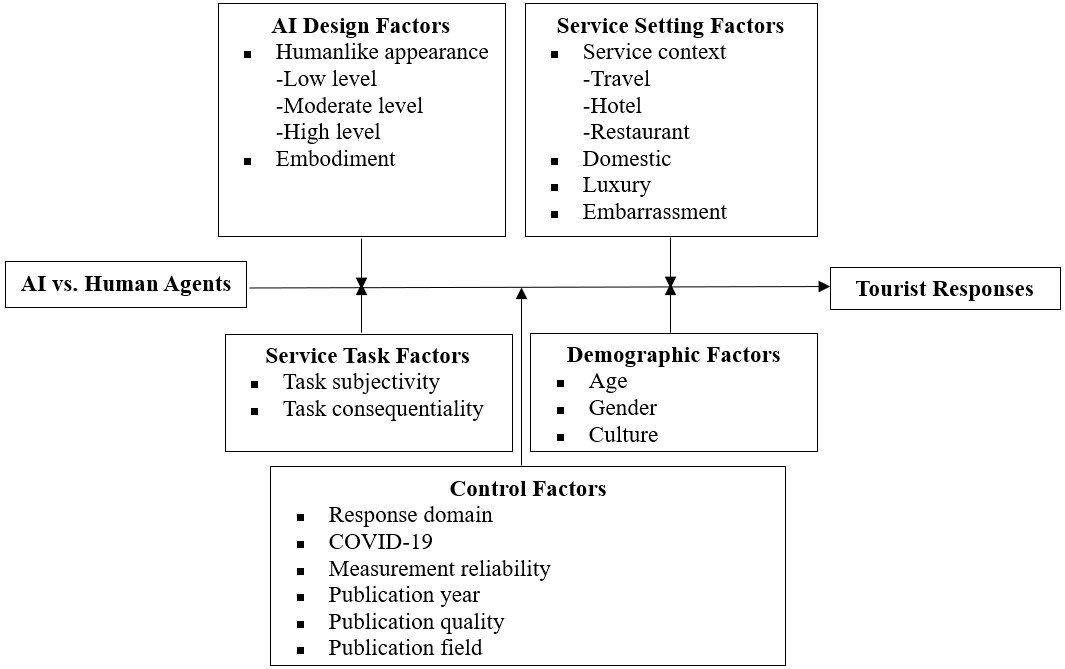
Figure Conceptual Framework
If you are interested in the research, please read the paper:
Peng, C. M., Sun, J. Y., Feng, C.*, Chen, Z. X., & Li, X. (Robert). (2026). Rethinking AI aversion in tourism: A meta-analysis of causal effects and contextual boundaries. Tourism Management, 117, 105475.
* Corresponding Author
A full version of this article could be viewed at:
https://doi.org/10.1016/j.tourman.2026.105475

Nanjing University of Aeronautics and Astronautics
Copyright 2017 | All Rights Reserved with NUAA