
The paper entitled “Dual geographical and institutional boundary effects on intercity disparity in public services,” co-authored by Hehui Yuan and Qunwei Wang, has recently been published in Regional Studies (ABS 4, ADBC A*, SSCI Q1). Both authors are affiliated with the College of Economics and Management and the Humanities and Social Sciences Laboratory of Jiangsu Province for Digital Intelligence Management and Low-carbon Operations for Manufacturing System, Nanjing University of Aeronautics and Astronautics.
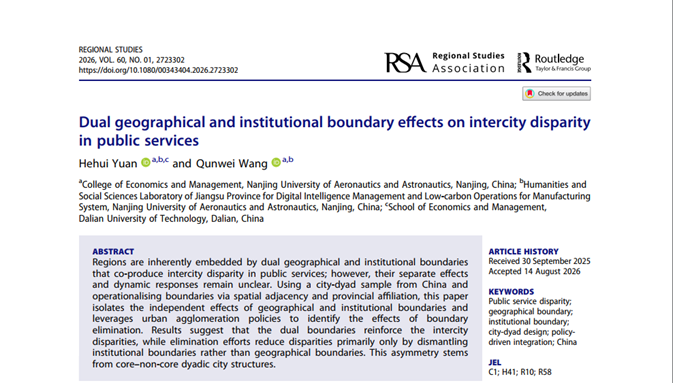
Spatial inequality is not merely a matter of uneven resource distribution, but a structural consequence of how geography and institutions divide territories. At the intersection of geographical isolation and administrative fragmentation lie the deepest spatial troughs of infrastructure provision, where the invisible architecture of boundaries perpetuates territorial disadvantages. This study advances a fundamental question: How do geographical and institutional boundaries shape the spatial architecture of inequality, and can regional integration dismantle these structural divides? This study develops a multi-layer relational spatial identification framework, drawing on longitudinal infrastructure project data from China. By integrating spatial topology, jurisdictional configurations, and counterfactual matching, the framework disentangles the independent effects of geographical fragmentation and institutional segmentation. Exploiting territorial integration policies as a quasi-natural experiment, the study employs staggered DiD approaches to identify the distributive consequences of policy-driven boundary elimination. By reconceptualizing boundaries as structural forces governing the geography of opportunity, this research advances theoretical understanding of territorial cohesion, spatial justice, and the political economy of regional inequality, offering new insights into how institutional restructuring can reshape the spatial distribution of public resources.
This paper can be cited as:
Yuan, H., & Wang, Q. (2026). Dual geographical and institutional boundary effects on intercity disparity in public services. Regional Studies. https://doi.org/10.1080/00343404.2026.2723302
A complete version of this paper can be accessed via:
https://doi.org/10.1080/00343404.2026.2723302

Nanjing University of Aeronautics and Astronautics
Copyright 2017 | All Rights Reserved with NUAA